

Over the past fourteen years (2011–2025), my research has focused on instrumental-variable quantile regression, panel quantile regression, controlling endogeneity via control-function approaches, and causal inference using machine learning. The central thrust of this work is twofold: addressing endogeneity in quantile models and developing machine-learning–based methods for causal inference. Alongside theoretical econometrics, I have applied the models I develop to firm-level panel data to analyze issues in finance and the broader economy.
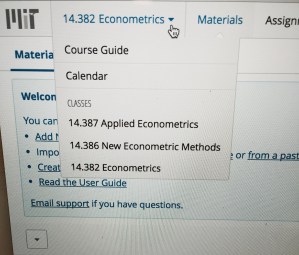
From August 2015 to July 2016, I was a visiting researcher in the MIT Department of Economics, where I completed Professor Victor Chernozhukov’s graduate course “Mostly Dangerous Big Data (Causal Machine Learning)” and Professor Joshua Angrist’s graduate course “Applied Econometrics: Policy Evaluation.” During this period, I studied a range of quasi-experimental methods and causal machine-learning techniques using household-level data and applied economic examples. One product of this work is a coauthored article (Chen and Hsiang, 2019, “Causal Random Forests Model Using Instrumental Variable Quantile Regression”) published in the peer-reviewed international journal Econometrics. In that paper, we apply Generalized Random Forests (Athey, Tibshirani, and Wager, 2019, The Annals of Statistics) to the identification of causal effects via instrumental variables and introduce a new causal ML approach to parameter estimation. Using instrumental-variable quantile regression, we estimate treatment effects across the outcome distribution and document how distributional information and variable-level importance shape quantile-specific effects. Applying the method to U.S. 401(k) participation, we obtain robust results relative to prior studies, thereby illustrating how economists can leverage natural and quasi-experiments in observational data to elucidate causal relationships.
Between 2020 and 2027, I have served as Principal Investigator on two JSPS KAKENHI projects: “Econometric Analysis of Quantile Treatment Effects Based on Causal Machine Learning and Its Applications in Economics” (Grant No. 20K01593, Category C) and “Design and Evaluation of Optimal Targeting Using Causal Machine Learning in Economics” (Grant No. 24K04823, Category C). Outputs include “Debiased/Double Machine Learning for Instrumental Variable Quantile Regressions,” published in Econometrics in April 2021 (one coauthor is with Microsoft Research’s Office of the Chief Economist), and “Exploring Industry-Distress Effects on Loan Recovery: A Double Machine Learning Approach for Quantiles,” also in Econometrics in 2023. In 2025, I coauthored “Recent Advances in Causal Machine Learning and Dynamic Policy Learning” with researchers from Stanford’s Department of Statistics, published in WIREs Computational Statistics. In recent years (the past two to three) and ongoing work, I have emphasized estimating heterogeneous treatment effects with causal ML and designing optimal policy rules (targeting). Concretely, in collaboration with the Taiwanese e-commerce platform PChome eBay Co., Ltd., we run marketing A/B tests (digital experiments) to generate randomized controlled trial data, estimate heterogeneous effects using state-of-the-art causal ML, and propose policy rules, which we then re-evaluate via subsequent A/B tests to compare alternative rules head-to-head. Going forward, I aim to advance empirical EBPM (Evidence-Based Policy Making) grounded in causal inference and to further develop econometric research that applies causal machine-learning methods.
In teaching, I emphasize two goals: cultivating evidence-based argumentation and building strong empirical skills. In my econometrics courses, I illustrate how quantitative methods can be used to address economic questions through concrete applications and structured discussion, while prioritizing proficiency with software such as R and Stata. In particular, I guide students through instrumental-variable quantile regression and causal ML to conduct hypothesis testing and causal analysis in economics. In my seminar, “Data Science for Economics: Causal Inference with Econometrics,” we progressively increase the use of English for discussion and materials, with the goal that students can comfortably take courses in English by graduation. I place a premium on small-group, two-way engagement and support students in developing domain expertise. Rather than relying solely on secondary citations, seminar students are expected to complete theses based on original research. I have supervised multiple undergraduate theses and master’s theses; among my advisees are students who pursued Ph.D. studies in economics at University College London, the University of California–San Diego, Johns Hopkins University, and Washington University in St. Louis, and a student who entered the Ph.D. program in Statistics at Stanford University. From June 2017 to August 2018, I organized joint seminars (“in-zemi”) with Professor Taro Takimoto’s group at Kyushu University, Professor Hiroaki Sasaki’s group at Kyoto University, and my group at National Taiwan University to foster inter-university collaboration and networks. Since 2018, I have taught “Machine Learning in Economics” at Tokyo International University; alumni include students who went on to earn a master’s in data science in the UK, a Ph.D. at Bayes Business School (City, University of London), and even an engineer hired by Facebook. In 2019, a master’s thesis by my advisee Nurazlaily Binti Mohamad Retha (then at GRIPS) was selected for GRIPS’s Best Policy Paper Award.
In terms of contributions to university projects and student development, I bring seven years of experience in the United States (NYU and MIT), six years in Taiwan, and seven and a half years in Japan, spanning applied econometrics and causal machine learning in both research and teaching. I connect theory to evidence through novel empirical approaches, support rigorous data analysis and quantitative policy evaluation, and help students master econometric methods and empirical workflows. Above all, I train students to develop what is indispensable in data-oriented careers: the ability to interpret results correctly.
 Jauer
Jauer 
コメントを投稿するにはログインしてください。